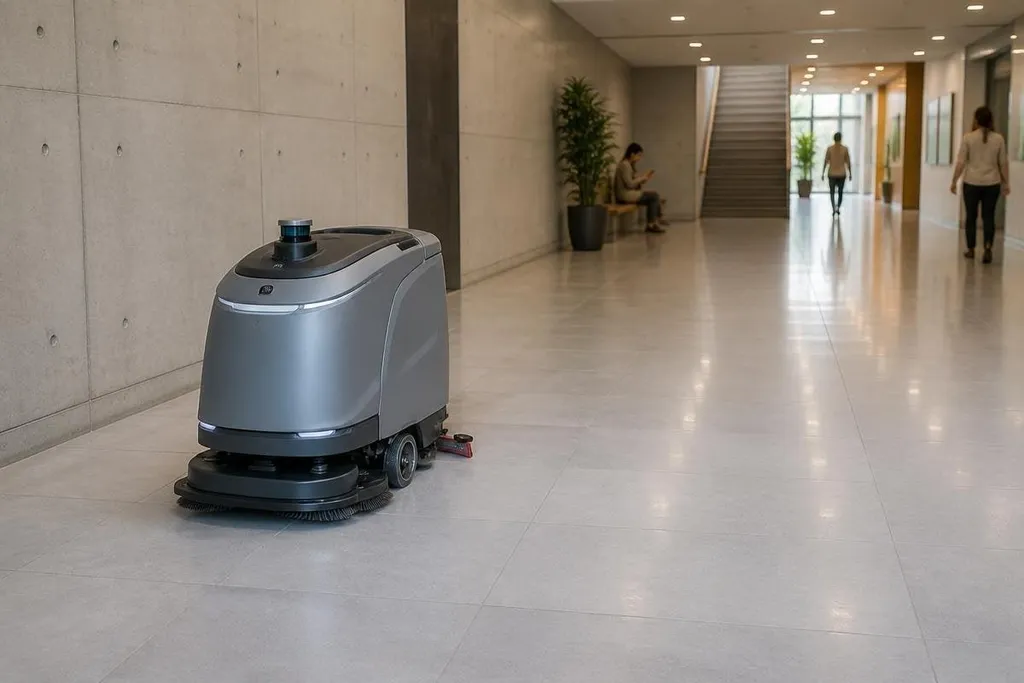
A commercial floor-cleaning robot has one job: leave a large floor clean without creating more work for staff. That sounds clear, but buyers need to check how the robot handles dirt, people, charging, water, and the edges of a building.
- Cleaning path: It should cover the assigned area without repeated passes.
- Staff time: Workers should spend less time driving, filling, and emptying the machine.
- Proof of work: Managers need records that show where and when cleaning happened.
How the machines work
Most commercial floor-cleaning robots combine a cleaning head, drive motors, sensors, and software. The cleaning head may scrub with brushes, spread water, and collect dirty water as the robot moves.
Sensors help the robot map its route and react to walls, furniture, people, and other obstacles. LiDAR, which measures distance with laser pulses, is one way a robot can build a map of its surroundings. Cameras and other sensors may add information about objects in its path.
That map matters because floor cleaning repeats the same work across a known area. A robot can follow assigned routes, return to a dock, and report its progress. The value comes from consistent coverage, not from moving quickly for a short demonstration.
Where the money can make sense
The best fit is a site with large floor areas and repeated cleaning work. Airports, shopping centers, warehouses, hospitals, and office buildings may have long routes that take staff hours to finish.
A robot can take on those routes while workers handle tasks that need judgment or close contact with people. Staff may still need to clean corners, stairs, spills, crowded areas, and places the robot cannot safely reach.
This changes the buying question. You shouldn't ask only how much floor the robot can clean.
Ask how much staff time remains after charging, filling the water tank, emptying dirty water, moving the robot between floors, and clearing blocked routes.
The cost also includes setup, service, replacement brushes, batteries, software, and training. A lower purchase price may not mean a lower operating cost if the robot needs frequent help during each shift.
Those costs make the cleaning result worth measuring across a full shift, not only during a short demo. A report from Robot24.com can place a robot’s claimed coverage rate beside its battery stops and the human help it needs. That record leads to the limits buyers should test.
The limits buyers should test
A clean map does not guarantee a clean floor. Dust, grease, wet patches, cables, mats, narrow aisles, and changing furniture can all affect the result. The robot also needs a safe way to stop when a person steps into its path.
Edges deserve a close check. A machine may cover the open center of a floor while leaving a strip beside walls or shelving. Staff then have to return with another tool, which can cut into the time savings.
Water handling brings another set of limits. The robot needs enough clean water for its route and enough tank space for the dirty water it collects. If workers must service it halfway through each run, the planned route may not match the working route.
A site trial should test the building during normal use. Run the robot when doors open, people walk through, stock moves, and furniture sits in its usual place. A clear floor at an empty site says little about a busy shift.
A buying checklist
Use this list before comparing models or asking for a quote:
- Map the floor: Record the area, surface types, stairs, lifts, doors, narrow routes, and cleaning zones.
- Measure staff work: Time filling, emptying, charging, moving, and rescuing the machine during a normal shift.
- Check edge cleaning: Inspect the strip beside walls, racks, fixtures, and other fixed objects.
- Test interruptions: Place people, carts, cables, mats, and temporary barriers along the planned route.
- Price the full term: Add service, consumables, batteries, software fees, training, and repairs.
- Set a pass rule: Agree on the cleaning result and staff time target before the trial starts.
What should happen next
Buyers should ask suppliers to prove cleaning results and staff savings inside the building where the robot will work. If the trial still needs frequent human rescue, the machine is an extra task, not a labour-saving system.
I'd skip any purchase based only on a polished demonstration. The better decision will come from a normal shift, a measured floor area, and a written record of every time a person had to step in.